
Every Doctor Visit Has a Hidden Scorecard
Every Doctor Visit Has a Hidden Scorecard
The clinical reasoning happening behind every consultation — and why AI is finally making it matter

The average doctor's appointment lasts about seven minutes. In that window, a physician is listening to your symptoms, running a physical exam, updating their mental map of your history, and doing something most patients never see: quietly building a list of everything else it could be.
That list is called the differential diagnosis. And it might be the most important thing your doctor does during your visit — more than the prescription they write, more than the test they order.
Most patients leave a consultation thinking about the diagnosis they were given. Physicians leave thinking about the ones they ruled out.
The Art of "What Else Could This Be"
A differential isn't a sign of uncertainty. It's a sign of rigor.
When you walk in complaining of a headache, a skilled clinician isn't just thinking "headache." They're running through a ranked mental list — tension-type, migraine, hypertensive urgency, medication overuse syndrome, subarachnoid hemorrhage — and eliminating candidates based on your answers, your history, your vitals, and dozens of subtle clinical cues you'd never notice they were collecting. The diagnosis you leave with is the survivor of a quiet elimination round that happened entirely inside your doctor's head.
Medical schools teach this process formally. Attendings drill it into residents. Every experienced clinician does it instinctively. But here's the thing almost no one talks about: this reasoning almost never gets written down.
In the best cases, a physician's notes might include a one-line mention of an alternative they considered and dismissed. More often, the differential exists only as a cognitive artifact — constructed, used, and discarded within the span of a single consultation. By the time the clinical note gets written (often hours later, after a full day of patients), the reasoning has been compressed into a conclusion: the diagnosis, the plan, the prescription. Everything else that was considered? Gone.
The Patient Safety Gap
The loss of differential reasoning isn't just an administrative inconvenience. It has real downstream consequences.
Consider what happens when a diagnosis proves wrong. Without a documented differential, there's no trail to follow. The next clinician who sees the patient starts from scratch, often without knowing what was already considered — and already ruled out. Conditions that should have triggered a red flag get treated as new information instead of pattern confirmation.
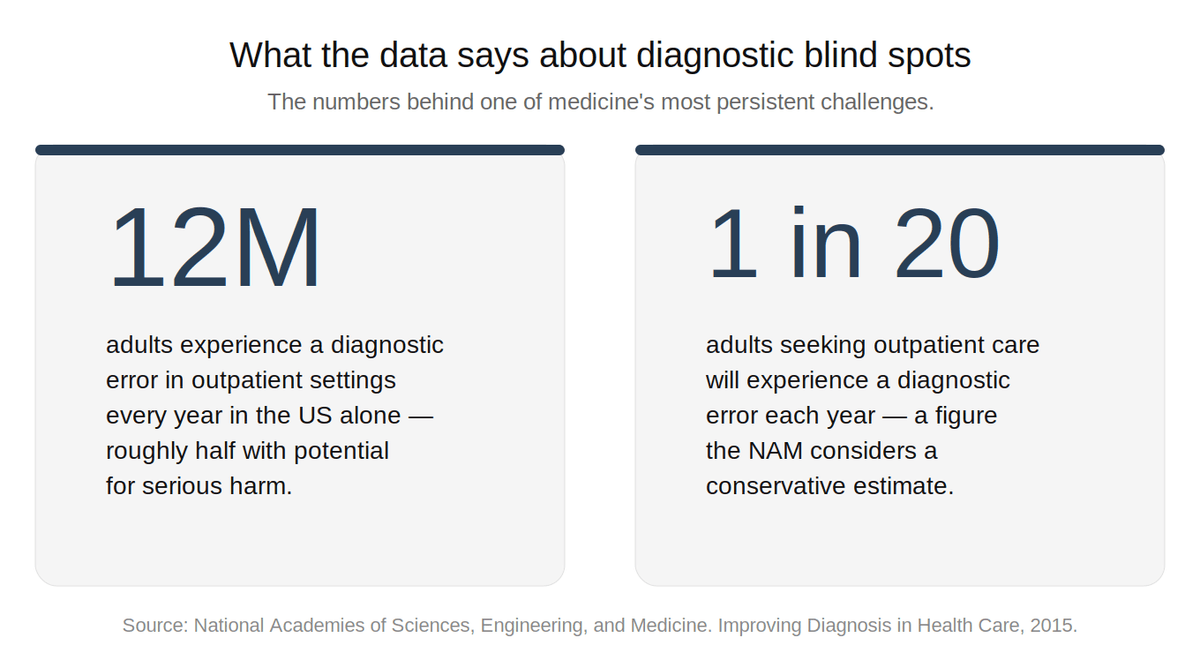
Research consistently shows that diagnostic error is one of the most prevalent sources of preventable harm in medicine. A significant portion of those errors aren't failures of knowledge — the physician knew the right answer was on the list. They're failures of documentation and follow-through. The differential existed. It just wasn't captured in a way that could be acted on.
There's also the issue of cognitive load. A physician seeing 30 to 50 patients a day is running the same diagnostic reasoning process dozens of times. Under that volume, differentials get abbreviated. Shortcuts emerge. The conditions that look most obvious get documented; the less likely but potentially serious alternatives get mentally noted and then mentally filed away. This isn't negligence — it's what happens when the documentation burden is heavier than the clinical one.
Where AI Scribes Enter the Picture
For the last decade, the healthcare industry has been focused on getting doctors to document more. More notes, more codes, more structured data. The result has been physicians spending more time facing screens than patients — a dynamic widely cited as a primary driver of clinician burnout.
Ambient AI scribes flip that equation. Instead of pulling the physician out of the consultation to document, they sit in the background and listen. The conversation happens naturally. The AI captures it, transcribes it, and generates structured clinical documents in real time — without the physician lifting a finger mid-visit.
But transcription is just the beginning. The more significant shift is what happens to the differential.
Sophisticated AI scribe systems don't just record what the physician said. They analyze the clinical picture as a whole — symptoms, history, medications, physician commentary — and generate a structured differential diagnosis that captures reasoning across multiple tiers: what the physician explicitly confirmed, what they flagged as worth investigating, and what the clinical data suggests as a working possibility the consultation may not have formally named.
The Second Pass Problem
There's a concept in medicine called anchoring bias: the tendency to lock onto the first plausible diagnosis and stop looking. It's well-documented, cognitively inevitable under time pressure, and one of the most common contributors to diagnostic error.
An AI observing a consultation in real time doesn't anchor. It holds the entire clinical picture simultaneously and can cross-reference it against patterns at a scale no physician can replicate in a seven-minute window. Not because it's smarter than the doctor — it isn't making the call — but because it isn't subject to the same cognitive constraints.
Think of it as a second pass. The physician runs their clinical reasoning; the AI independently surfaces what the documented findings could also suggest. The physician still decides. The AI just ensures that the thinking doesn't silently evaporate when the appointment ends.
This is a meaningful distinction from how AI in healthcare is often framed. The narrative tends toward replacement — AI making the diagnosis. The more realistic and more immediately useful version is AI preserving the diagnostic reasoning so that it can be reviewed, validated, and acted on by the clinician who was there.
What a Documented Differential Actually Does
When differential reasoning is captured properly, several things become possible that weren't before.
For the individual patient, a documented differential is a clinical record that follows them through the system. If a diagnosis later proves incorrect or incomplete, there's a trail showing what was considered and why the decision went the way it did. Subsequent physicians don't start from zero — they inherit the reasoning, not just the conclusion.
For the physician, documentation of clinical reasoning provides defensibility. In a landscape where medical liability often hinges on whether a clinician exercised appropriate judgment, a structured differential is evidence of exactly that. It shows the thought process, not just the outcome.
For the healthcare system at large, differentials captured at scale become data. Patterns in diagnostic reasoning — what conditions get considered together, what red flags get surfaced most often, where diagnostic errors cluster — become visible and learnable in ways they simply aren't when reasoning stays locked inside individual physician cognition.
We're Still Early — But the Direction Is Clear
AI-assisted differential generation is not yet standard. Most AI scribe tools on the market are still primarily focused on reducing note-writing time — a genuinely valuable problem to solve, but a narrow one. The systems that go further, that treat the differential as a first-class clinical artifact worth capturing and structuring, are at the leading edge of where this category is heading.
The underlying clinical need has always been there. Physicians have always reasoned in differentials. The failure has been in building systems that make it practical to preserve that reasoning at the pace and volume of real-world clinical practice.
That's the gap AI is closing. Not by replacing the doctor's judgment — but by making sure it doesn't get lost on the way to the chart.
The best consultations have always been about more than the diagnosis you leave with. Now, the technology exists to make sure the full picture doesn't disappear the moment the door closes.
AI-powered language aware clinical documentation built for south-east asian clinicians
BetterClinic listens to your consultations, generates structured SOAP notes and differential diagnoses in real time, and handles PhilHealth compliance — so you spend less time on paperwork and more time with patients.